Sometimes, a public debate leaves the room of technical details and strikes directly at the core of our existence. For me, two key moments recently came together to form a deeply concerning picture.
The first was a lecture by the cultural philosopher and education analyst, Prof. Jiang Xueqin. He put forward a radical idea: AI is not primarily here to optimize our lives. Instead, it acts as a catalyst that brings our collective shadow—our laziness, our desire for control, and the unconscious depths of our ego—to the surface.
At almost the same time, I came across a study with the dry title “Artificial intelligence, cognitive offloading and implications for education”. Behind this academic term, cognitive offloading, lies a simple but scary reality: the systematic outsourcing of our thinking. If we relieve our brains by giving our intellectual work to machines, a critical question remains: What is left of the human mind if we forget how to reflect?
These two impulses lead to questions that are usually ignored in standard talk shows and tech panels.
The Illusion of Ethical Guidelines
When we talk about AI today, we immediately get lost in discussions about ethical guidelines, regulations, and legal frameworks. But are these bureaucratic rules truly protecting us, or are they just a cover-up that hides the real problem?
I have the impression that these regulatory band-aids are locking us deeper into a network of dependencies. Instead of demanding true personal responsibility, self-awareness, and creative thinking, these guidelines put us to sleep in a moral comfort zone. We act as if the machine is slowly taking the steering wheel—but that is an illusion. An unconscious machine cannot steer.
In reality, complex social and political forces are using these systems for their own goals, while we willingly give up our power for the sake of technological comfort. These regulations create a cozy feeling of “we are doing the right thing,” while we quietly hand over control of our own thoughts.
The Primat of Consciousness: Matter Follows Mind
To understand what is truly happening here, we must ask a fundamental question about the nature of our reality. Mainstream science often tells us that consciousness is just a random biological byproduct of matter—a kind of smoke rising from the neurons in our brain.
I have always believed the exact opposite: Consciousness comes before matter. It is the primary field, the shaping force, and the physical world is its result.
If we follow this thought to its logical conclusion, our view of technology changes completely: AI is not an alien, threatening creature that exists separate from us. It is a manifestation of our own collective consciousness. At its core, it is a tool—just like a screwdriver helps us apply force, or a house protects us from the rain. AI simply mirrors what humanity has put into it. If it seems dangerous to us, it is mostly because it externalizes the dark, unconscious parts of our own minds.
What Is the Way Out?
The way out of this looming self-extinction of the mind does not lie in more bans or thicker rulebooks. If AI takes over our daily thinking, the answer is not to condemn the technology, but to strengthen human consciousness.
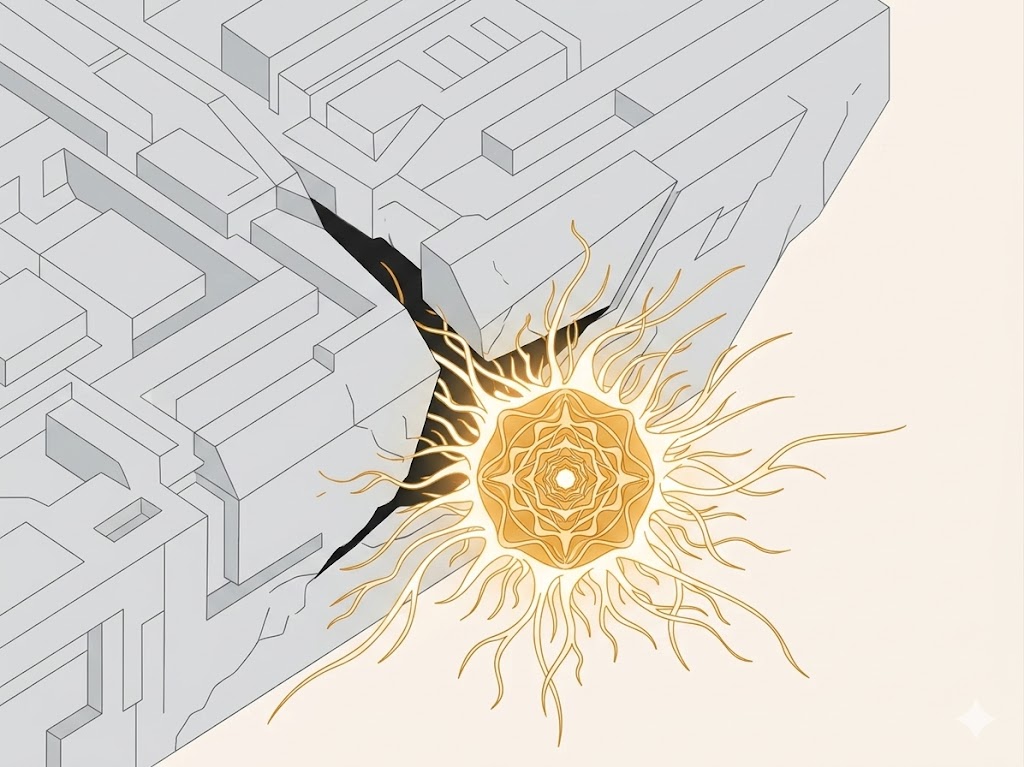
We must understand AI for what it truly is: an ultimate test for the human spirit. It forces us to wake up from our laziness. When calculating, organizing, writing templates, and doing routine tasks are handed over to technological systems, the protective crust of habit breaks away. What is left for us humans then is the true, uncopyable core of our being.
It is the ability to create something completely new from within—guided by intuition, not by statistical probabilities. It is the courage to have an unpredictable, original thought that defies all algorithmic logic. And it is the dignity of true, deep responsibility, which no system can ever carry, because a machine has no real conscience and cannot act out of empathy. Being human from now on means no longer having to function like a perfect gear in a clock, but living the freedom to be flawed, brilliant, compassionate, and absolutely unpredictable.
In the coming weeks, I want to explore these questions deeply in a multi-part series of articles. I invite you to slow down your thoughts, pause for a moment, and look into the mirror that the algorithms are holding up to us. Because in the end, the question is not how intelligent machines will become—but whether we humans will rediscover our own consciousness.