The Template is Burning: Why We Overestimate AI and Castrate Our Own Minds
We live in an age of digital euphoria. We are told that Artificial Intelligence will soon replace everything that defines us: our thinking, our creativity, our decisions. Entire education systems are already surrendering to the convenience of algorithmic feedback, confusing the mechanical reproduction of knowledge with true transformation.
I tell you: this is a fatal misconception. The machine does not learn. It only calculates.
Over the past 40 years of my career—from starting at the workbench as a master car mechanic, to leadership roles at BMW AG, to the strategic planning of international TVET (Technical and Vocational Education and Training) projects like the SGAVE project at Tongji University in Shanghai—I have learned one thing: True excellence never emerges in the abstraction of a sterile space. It is born through resistance against matter. It arises where we learn to solve problems that cannot be found in any textbook.
The Illusion of “Intelligent” Code
What we are currently celebrating as AI is simply the perfection of the template. Large Language Models spit out the statistical average of our collective, past knowledge. They are brilliant at weaving quantitative fabrics. But they do not possess a single spark of creative power. Why? Because they lack the very foundation upon which all true consciousness rests: biology.
Our thinking does not just happen in the neocortex. We make decisions, comprehend, and navigate the world using a biological compass. Our intuition, our so-called gut feeling, is the highly precise, evolutionarily refined evaluation of biochemical processes. It is a haptic intellect that relies on resonance with the real world. Software running on silicon feels nothing. It has no existential crisis, no ethical responsibility, and no lived experience.
If we restructure our educational institutions and curricula so that young people only learn how to feed prompts into machines, we are training a generation of template managers. We are stripping them of the most vital human experience: the pride of having forced a workpiece—whether made of wood, metal, or thought—into reality through their own resistance and their own mistakes.
The Unpredictable Mind Strikes Back
We must not surrender the steering wheel without a fight. The future of technical education (TVET) and human progress does not lie in training ourselves to become better machines. It lies in cultivating exactly what makes us unpredictable.
- The Qualitative Art over the Quantitative Duty: Machines can optimize. But only the human mind can deliberately shatter the template to create something entirely new.
- Embodied Cognition: True competence is always bound to the living body and to practical experience. Knowledge without action remains a hollow shell.
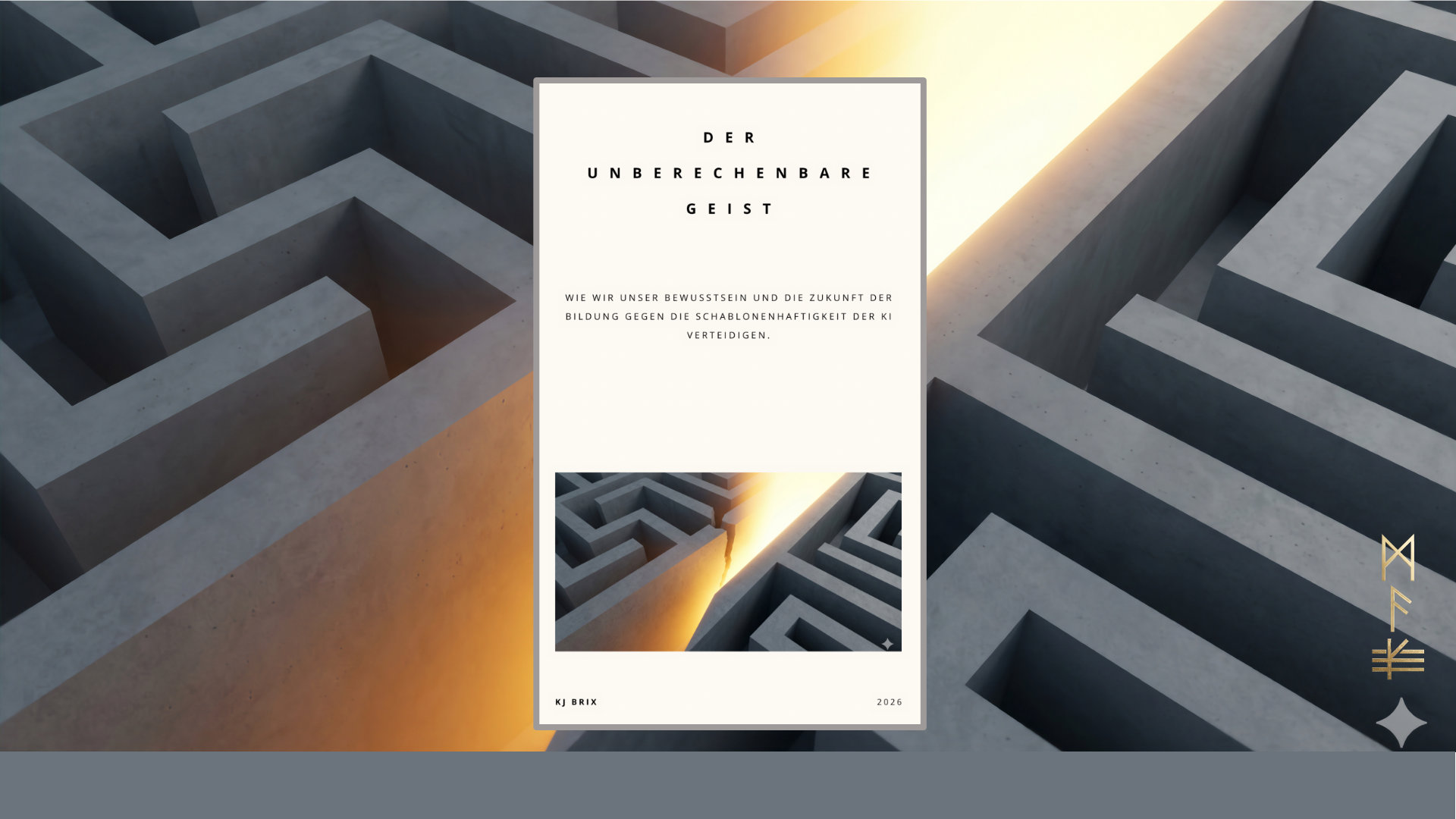
In my new book, “Der unberechenbare Geist” (The Unpredictable Mind), I dive right into this conceptual seam. It is not a technophobic lament, but the living blueprint of a TVET architect who views AI as a tool—while fiercely defending consciousness as the exclusive domain of humanity.
Let’s not be talked into believing we are just biological software waiting to be phased out. Let’s sharpen the blades of our intellect, take back the wheel, and defend our creative fire against digital conformity.
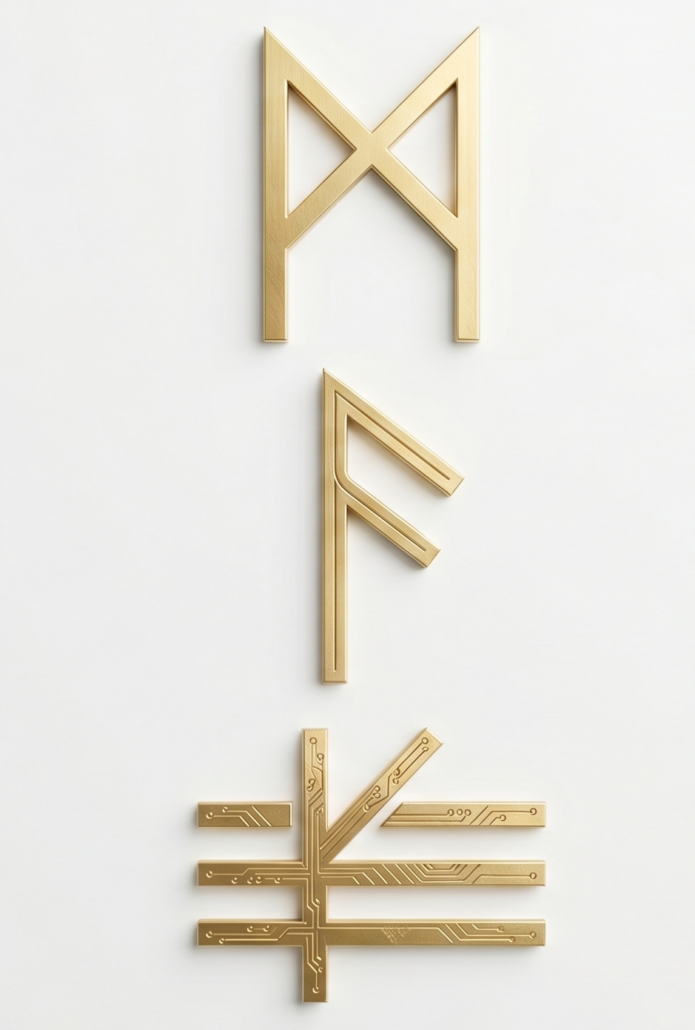
Explanation of the symbols on the spine of the print version – Nordic rune script
Top: Mannaz (ᛗ) – Man, the reflective self, and the intellect.
Middle: Ansuz (ᚨ) – The creative spark, the spiritual breath, and the living consciousness.
Bottom: The new AI symbol – A stylized, more angular “twig” that symbolizes the code and the quantitative fabric.