New project: “Zero Waste Egg Farming” – How a local teacher, an AI and I are building an e-learning course (Part 1)
Those who follow my blog closely know that I’ve fallen in love with the Philippines. I recently wrote about the unforgettable father-son motorcycle trip through this fascinating country. But my connection to the Philippines now goes far beyond travel. Today I’d like to announce the launch of a new passion project: the development of a digital course on the topic. „Zero Waste Egg Farming“.
This post is the start of a short series in which I will take you behind the scenes of price development.
The idea: A closed loop for the future
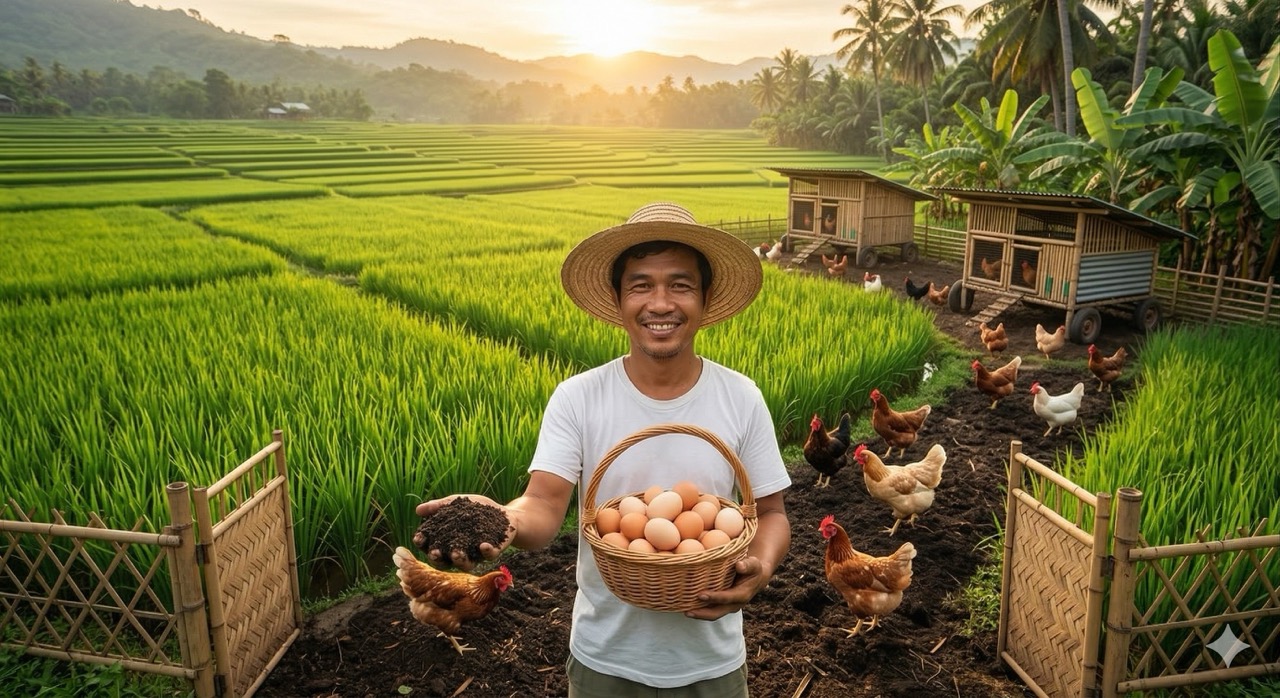
Global agriculture is undergoing a transformation, and in the Philippines in particular, environmentally friendly poultry farming has evolved from a niche phenomenon to a central strategy. The goal is ambitious but logical: all waste streams should be transformed into valuable resources within a closed system.
In our course, we want to present this fascinating knowledge in a comprehensive way. We’ll be exploring concepts like the so-called “Filipino Chicken Tractor on Steroids”—a system where chickens are kept in a closed loop that efficiently utilizes agricultural waste, rice pulp, and animal manure. Such regenerative approaches are not only ecologically sound, but also significantly reduce costs for farmers through the use of local resources and innovative methods.
The magic triangle of cooperation: Negros, Germany and AI
A project like this cannot be managed solely from a desk in Germany or Shanghai. The creation of this course is based on a completely new and fascinating form of collaboration for me:
- 1. Local expertise (The partner on Negros):The Philippines already has government institutions that provide guidelines and competency modules for organic farming. But theory needs practice. My partner, a dedicated teacher on the island of Negros, brings precisely this local knowledge and teaching experience. He knows how people learn locally and which challenges—such as managing extreme heat stress for animals in the tropical climate—really matter in practice.
- 2. The e-learning architect (me):This is where my experience as a trainer comes into play. My task is to structure the complex biological principles – such as the precise 1:1:1 composting formula – in such a way that they can be taught intuitively and in a motivating manner within a Learning Management System (like the one I already run as a demo).
- 3. The digital translator (AI / Gemini):Back in January, I described on this blog how I use Google NotebookLM to update my Udemy courses. In this project, we’re taking it a step further: We’re using AI.Geminias a central sparring partner. Gemini not only helps us to overcome language barriers fluently, but also to structure the extensive research. The AI analyzes agricultural studies for us, compares them with local regulations, and supports us in transforming dry facts into interactive learning modules. I then use NotebookLM to create the learning materials.
What happens next?
This project is, for me, the perfect symbiosis of education, technology, and cross-border collaboration – themes that are deeply ingrained in the DNA ofkjspaceare anchored. In the coming weeks, I will show you in further posts how we are building the specific modules and what challenges we encounter in creating the course.
Stay tuned!
Links to topic series:
Zero Waste Egg Farming Link
VEKI³ Link